
My PhD thesis ‘Population dynamics of infectious disease and pathogen evolution: modelling vaccine escape’ (2025) is available here, including a technical abstract (an extended summary is available here). Below is a graphical abstract and a ‘lay summary’ for the general reader.
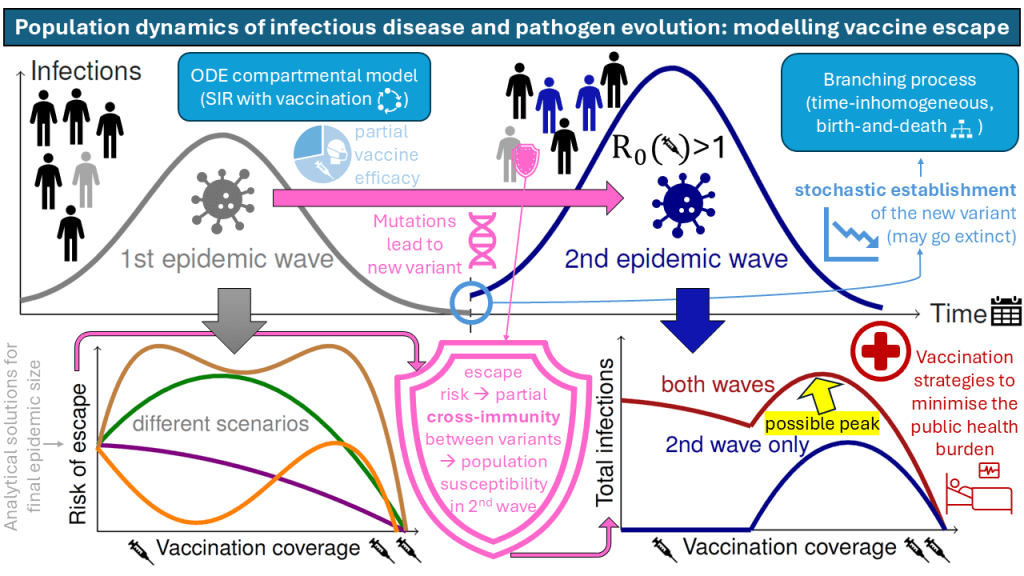
Vaccines are a powerful tool to control infectious diseases. However, many pathogens — such as SARS-CoV-2 and the Influenza virus — can mutate to bypass the immunity provided by past infections or vaccination. For example, the Omicron variant of SARS-CoV-2 substantially escapes the protection against infection of individuals vaccinated with the original COVID-19 vaccines. Since a high level of immunity in a population is often necessary to minimise disease transmission and hospitalisations, the public health burden of epidemics can substantially increase due to immune escape variants. Unfortunately, immunity itself can drive pathogen evolution towards immune evasion. Hence, partial population immunity (induced by vaccination or infection) may be a double-edged sword for epidemic control. This motivates the central question of the thesis: how does the risk of immune escape during an epidemic depend on the vaccination coverage of the host population?
The thesis describes epidemic spread in a population with mathematical models of differential equations. The analytical solutions of these models are used to measurethe pathogen’s incentive to evolve towards immune escape. Rather than modelling specific genetic mutations, the thesis uses a simple evolutionary approach, giving results applicable to many pathogens. The thesis studies how changing the vaccination coverage and other epidemiological parameters (such as the vaccine efficacy) alter the risk of immune escape evolution. It also studies the public health consequences of these evolutionary changes.
We find that the highest risk of immune escape might occur at intermediate vaccination coverages, in line with previous work. However, we also find another possible pattern: that any level of vaccination in the population reduces the overall immune escape risk. This novel pattern appears if infections in vaccinees do not favour the emergence of escape variants substantially more than infections in unvaccinated individuals.
The thesis also considers other differences between individuals important for evolution. Some people (such as those with weakened immune systems) may allow pathogens to adapt faster. This type of population diversity can lead to more complex patterns where the risk of immune escape peaks at two different vaccination levels. These findings inform decisions about who should be prioritised for vaccination, to minimise either the total infections or the escape risk.
The thesis also studies evolution when reinfections are possible. If past infection provides only partial protection and vaccines provide stronger protection, vaccination always reduces the risk of immune escape — regardless of how quickly the pathogen adapts in people with prior immunity.
The thesis also determines whether new escape variants can successfully spread. Using probabilistic methods, it shows that the existing strain can prevent new variants from establishing, especially if they emerge late in the epidemic. This can lead to surprising situations where intermediate vaccination levelsminimise the risk of successful escape.
Finally, by considering a new epidemic with an escape variant, the thesis translates evolutionary risks into public health outcomes. It finds that it is theoretically possible for the overall disease burden to be highest at intermediate vaccination levels. However, for almost all parameter values, vaccination reduces the overall public health burden.

